

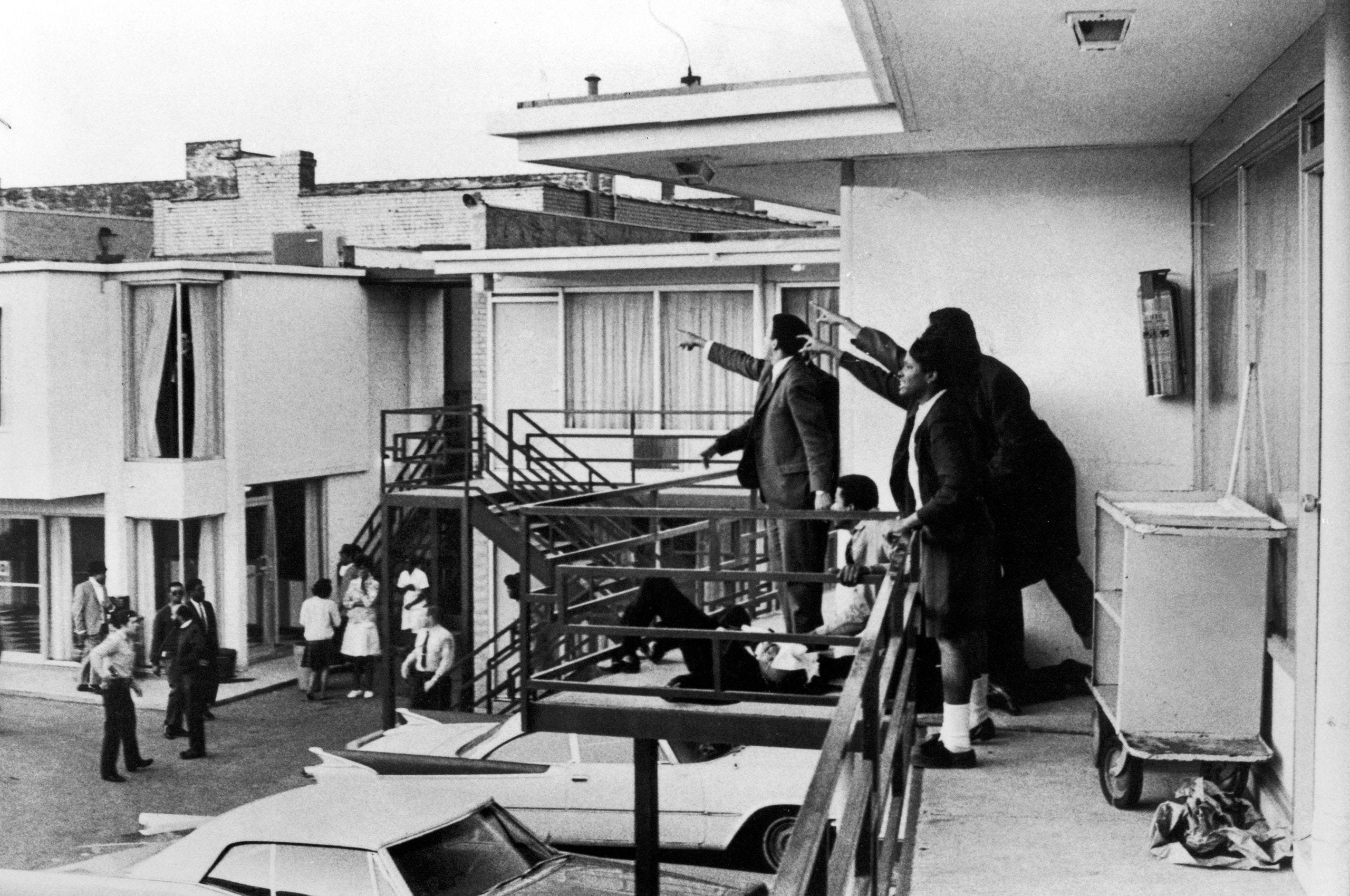
I was in Memphis for a wedding this weekend and did what wedding guests in regional cities do: touring historical sites I’ve read about but wouldn’t go out of my way to visit a city for.
The major attraction that grabbed my interest was the Lorraine Motel, which houses the National Civil Rights Museum. However, it was a working hotel (and one uniquely friendly to Black travelers) back on the night of April 4, 1968, when the lodger in Room 306, the Rev. Dr. Martin Luther King Jr., stepped onto his balcony and was killed by an assassin’s bullet.
King’s work in life was momentous, and I trust you’re already familiar with the highlights, but his earthly work ended on that balcony. Everything that happened next—the continuing civil rights movements, the federal holiday, the movies, the street namings—all of that was our choice as a society. King’s active intentions had nothing to do with it.
See, in life, we can make our own choices, even if we can’t control how others react to them. But in death, and whatever happens with it, how we’re remembered and what our legacy means are societal decisions.
The Lorraine Motel, where this awful act of political violence happened, could have continued on as a private business, or been torn down and developed into a shopping mall, but instead was turned into a museum—dedicated to illustrating the long history of injustice and celebrating the people who have sacrificed everything to resist it.

The day I happened to be visiting was one of celebration. The museum had just completed construction on a park adjacent to the grounds and was holding a grand opening with music, libations, and activities for all ages. It was a real contrast, sitting on a bench looking up at the balcony where a life was taken, all while listening to the sounds of people mingling and laughing.
But I have to say—I loved it. I love our human capacity to take the worst things that happen and choose to focus on the positive. I love the notion that places where great evil is perpetrated can become places where children can sing and dance and learn about their history.
There’s a word we Catholics like, hagiography. Technically, it’s the practice of writing down the lives of the Saints. Practically, we see it used more often to describe the tendency in society when someone passes away to remember them in their best light.
This practice has become a flashpoint again in the days since Charlie Kirk’s assassination. The act of political violence has been widely condemned on both sides of the American political spectrum, but if you’re in a Left-aligned bubble you’re likely to see more snippets of his work that promote hatred and division. If you’re in a Right-aligned bubble, you’re more likely to see him talking thoughtfully about shared social values or in candid home videos playing with his children. No wonder both sides are confused and frustrated by how the other is reacting.
And the conflict over paying respect to the dead versus critically examining their legacy isn’t unique to Kirk. I first learned about Margaret Thatcher because we saw The Iron Lady as a family in 2011. When she passed, hundreds of world leaders issued statements celebrating her legacy. But when Channel 4 asked a few everyday Scottish people what they thought about Thatcher, they got a very different perspective.
Just the other week, the Chicago Teachers Union posted a tweet celebrating the life of Assata Shakur.
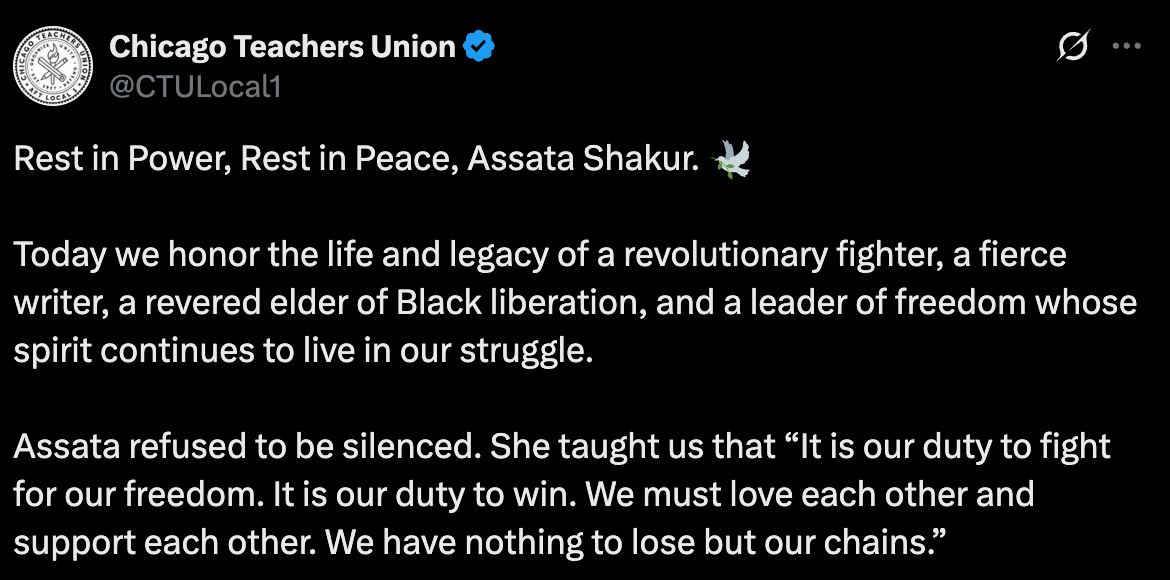
The message lauds Shakur’s activism and legacy. It fails to mention the part where she was convicted of murdering a New Jersey state trooper, escaped prison, fled to Cuba, and became the first woman added to the FBI’s Most Wanted Terrorists list.
Just like we disagree over people’s contributions during their life, we disagree about how to celebrate their legacy after their death. I’m not trying to weigh in on any individual figure, and I’m certainly not trying to compare the works of Kirk and King, but rather I’m curious about how we choose to celebrate or demonize the people who have passed on.
Obviously, the stories we tell about the deceased become part of our shared cultural narrative, and influence how people think about the world, as well as the figures who made it what it is today. But, it’s become common to see people attack or question famous figures’ legacies in order to delegitimize their work and the social movements they’re affiliated with. Indeed, Kirk himself participated in a chorus that’s grown in recent years to criticize King for his mistakes in life—the affairs and hypocrisies that didn’t make the textbooks I was brought up reading.
Deciding how to remember the dead is a delicate and difficult issue. For what it’s worth, and this is just my tendency—I’m not arguing that you need to think of things the same way—I like that society generally endeavors to remember what was best about people.
Human frailty is such that all our lives are collections of good and bad, and of course the ratio between the two differs, but when someone passes on—and the choice of what to do with their life becomes societal rather than individual—I think it speaks to our better angels that we so often choose to celebrate the good and brush past the bad.
Look, this is a feeling I have about the world, but is that a logically sound sentiment? Absolutely not. Swiss cheese has fewer holes.
First, there’s obviously a tension between that concept and the need for us to understand history accurately and critically. Thomas Jefferson was an American hero and a brilliant political theoretician. He was also a rapacious slave owner whose very real misdeeds in life are an essential component of understanding his role in history. But is that his chief legacy? I don’t think I’d make that argument, but I’m not sure my opinion on that should matter more than the lived experiences of the people he owned.
Second, who gets to say how a person is remembered? You, as an individual, of course get to choose how you’ll remember someone, but it’s hard to imagine you won’t be influenced by how society as a whole remembers them. However, that social memory is an accumulation of a lot of individual memories, so it’s really a whole chicken and egg thing. Plus, just look at all the examples above re: Kirk, King, Shakur, and Thatcher—smart and well-intentioned people have very different perspectives on those people and their legacies.
Third, there’s a real risk of people using the deceased’s legacy to justify bad actions after they’re gone. Movements love their martyrs, and plenty of injustices have been perpetrated throughout history as justified retribution for a notable death. While celebrating the good about what a person may have done, or at the very least extending empathy to a fellow human being, doesn’t at all endorse bad actions, I think it feels like a slippery slope to many.
Finally, memory isn’t static. In the latter half of the twentieth century it was common to talk about Confederate General Robert E. Lee as a distinguished American who may have chosen the wrong side but never gave up his honor. Hell, the man took up arms against the United States and a century later the Navy named a nuclear submarine after him. Well, that ship has been scrapped, and today I think it’s highly unlikely that we’ll see a groundswell of new memorials for Lee, who is remembered a lot less fondly now than he was then. We’re constantly revising our opinions on historical figures as new perspectives come to light and our social views change.
All this is to say, I get it. How we remember people is complicated, both as individuals and as a society. I’m just sharing that my personal bias for the simple version of the conversation is to try and look for what was good in a life—what’s worth celebrating and perpetuating. And I like it when society does that too. I like when we take tragedies and turn them into fuel for a better world. I like that children can laugh in a new Memphis park while learning about the troubled history of what happened there. It may be oversimplified and it certainly doesn’t mean we shouldn’t have more difficult conversations about legacy, but I think a positivity-first outlook probably leads us all to a better place.
I’ll leave you with Ted Lasso saying the thing I took 1,500 words to write in about twenty seconds.
Thanks for tuning in. As always, if you love every word or if you think I’m the internet’s dumbest boy, feel free to let me know directly or in the comments. See you next time.
You're the internet's dumbest boy