

Your eyes do not deceive you. It’s not Tuesday or Friday or the end of the month, but here we are with more Pound Foolish. I want to experiment with shorter posts in addition to our regularly scheduled content.1 Call them Penny Wise compared to the typical Pound Foolish; smaller, but hopefully just as interesting.
Last week’s political assassination of commentator Charlie Kirk has shaken the nation and the world. I was one of the unlucky few (or many?) who saw the close-up video before I realized what I was watching, and even after two decades on the internet I have to say that it was haunting.
I played countless hours of Call of Duty growing up and have watched more violent TV and movies than I care to admit. But the violence of my childhood media consumption and world history was always cast in the heroic light of grandparents storming the beaches of Normandy or knights in shining armor slaying dragons in story books. In those narratives, violence is a tool by which the just protect us against the unjust. However, the facts that evil must be defeated or that heroism exists don’t change the fact that violence is a horror.
I spent my first job out of college working on gun violence mitigation in Chicago. Still, I don’t think I really had a sense for just how horrific the destruction wrought by these weapons of war was until I spent time with the Washington Post’s excellent article on AR-15 rifles a few years back (disclaimer: that article is not for the faint of heart).
Kirk’s death, which I witnessed on social media, jarringly inserted amidst my usual diet of book content and cooking recipes, has played repeatedly in my head over the past week.
I’m increasingly concerned about the rise of violence in our politics. Violence begets violence; it is a contagion that spreads like wildfire and is tremendously difficult to put back in the box once unleashed.
The perpetrators of violence bear the ultimate responsibility for their actions, but my sense has always been that it’s impossible to separate the deeds of these madmen (and let’s face it, it’s almost always men) from the cultural context they emerge from.
The rush to label each perpetrator of violence, especially political violence, as left or right, in the immediate moments after every new tragedy strikes me as tremendously unhelpful. Partially, because I think it’s a way to quickly demonize the other side, but mostly because I think it’s a means to abdicate the responsibility I believe we all have to contribute in some small manner to a culture that doesn’t just condemn violence but cures the conditions in which it germinates.
This isn’t a “both sides have problems” take, by the by. Smarter people than me are talking about the varying culpability of cultural contributions across the political spectrum and you can go find those if you want a more partisan angle. I’m not here to argue against those takes, but instead to offer some thoughts on the responsibility we all share.
You might reject any responsibility, and that’s of course your right, but if you sense there might be some truth to my words or you consider yourself persuadable on the issue, let me offer two great analogies smarter men than me have come up with this week.
The first comes from Derek Thompson and his excellent new essay, All the Sad Young Terminally Online Men. Thompson uses a weather analogy (emphasis mine).
Political violence is akin to a lightning strike. It is somewhat random, and it’s rare. But lightning emerges from a local weather system. And we all make the weather. The political and media climate is co-created by all of us.
You should read the entire article, especially if you share my concern that rising tides of violence are inseparable from the masculinity crisis in this country, but Thompson ends it with another call to action based on this metaphor that I’d like to flag.
This assassination was drenched in the digital consciousness that is co-created by you and me and everyone we know and everyone we don’t know. We cannot stop each lightning bolt, and yet we are the weather.
The second analogy comes from Tim Urban of Wait But Why fame. Tim has always had a knack for distilling complicated concepts into accessible and memorable visuals, but this doodle, put up the day after Charlie Kirk’s assassination, is one of his best.
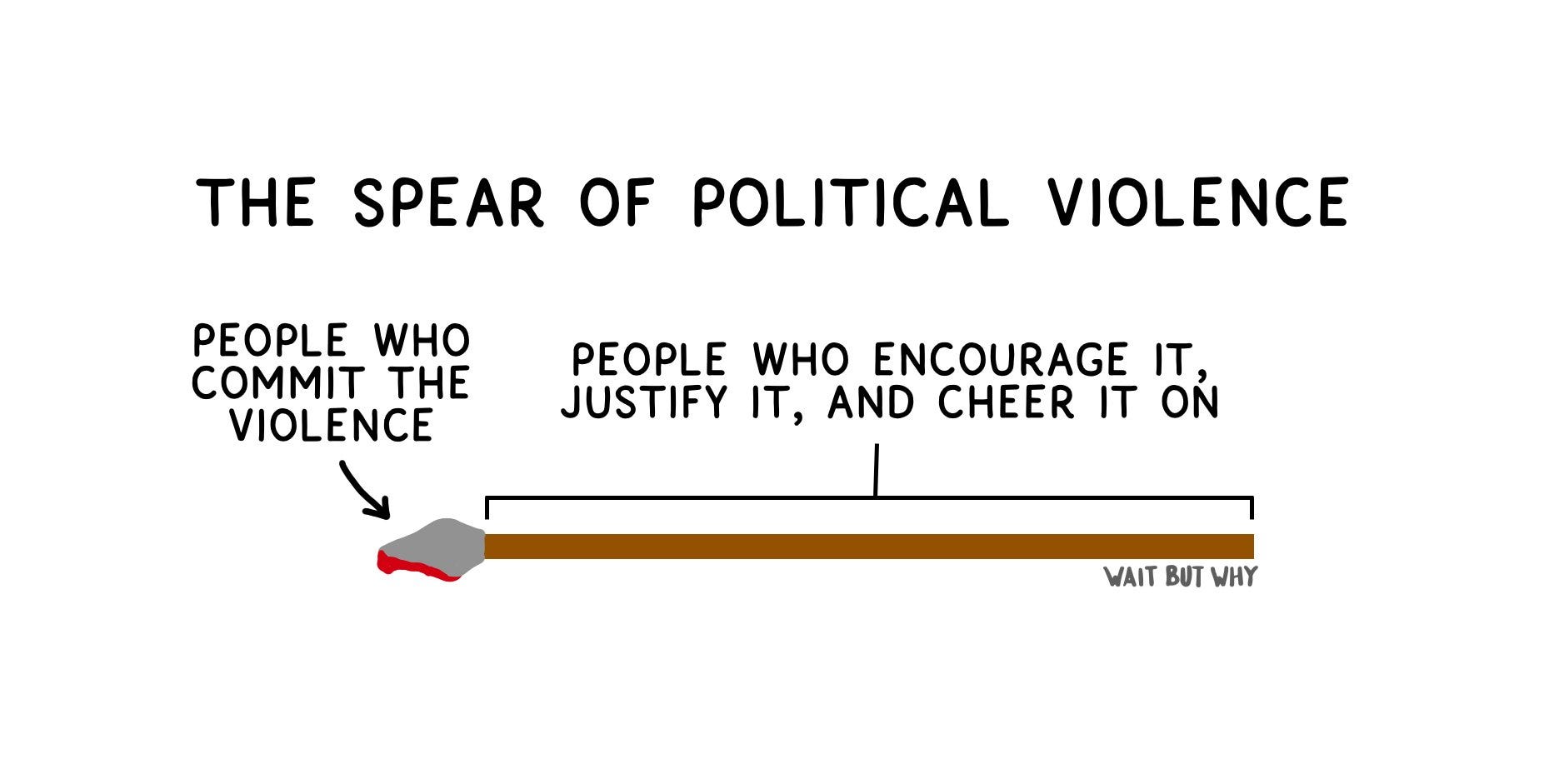
His original post was accompanied by the following caption:
Very few of us know the people at the tip of the spear. We can make the biggest impact by uniting against the handle, making that behavior far more taboo than it is now.
I continue to believe that the internet makes it uniquely easy to dehumanize the opposition, but if we’re going to move forward from this moment towards something better, then we all need to find ways to improve the conversation. The easiest way to start is by taking more responsibility for how we each individually contribute. You know better than I do what that looks like in your life.
I’ll leave you with some snippets of Ezra Klein’s excellent podcast voiceover covering his initial thoughts on the assassination, which is available via print here. The prose is stitched together and, again, the emphasis is mine.
I believe this so strongly: We have to be able to see that the bullet that tore into him was an act of violence against us all…All I can say, for me, in the work I do, is I want to create a space that takes our disagreements seriously and takes the stakes of them seriously — but does so without deepening our divisions irreparably. We are going to have to live here with one another. We’re going to have to be friends and foes at the same time.
Thanks for tuning in. As always, if you love every word or if you think I’m the internet’s dumbest boy, feel free to let me know directly or in the comments. See you next time.
*He wrote optimistically, before producing another 1,000 words…